Hosting a Nikah or Walima: Private Invites and a Shared Album
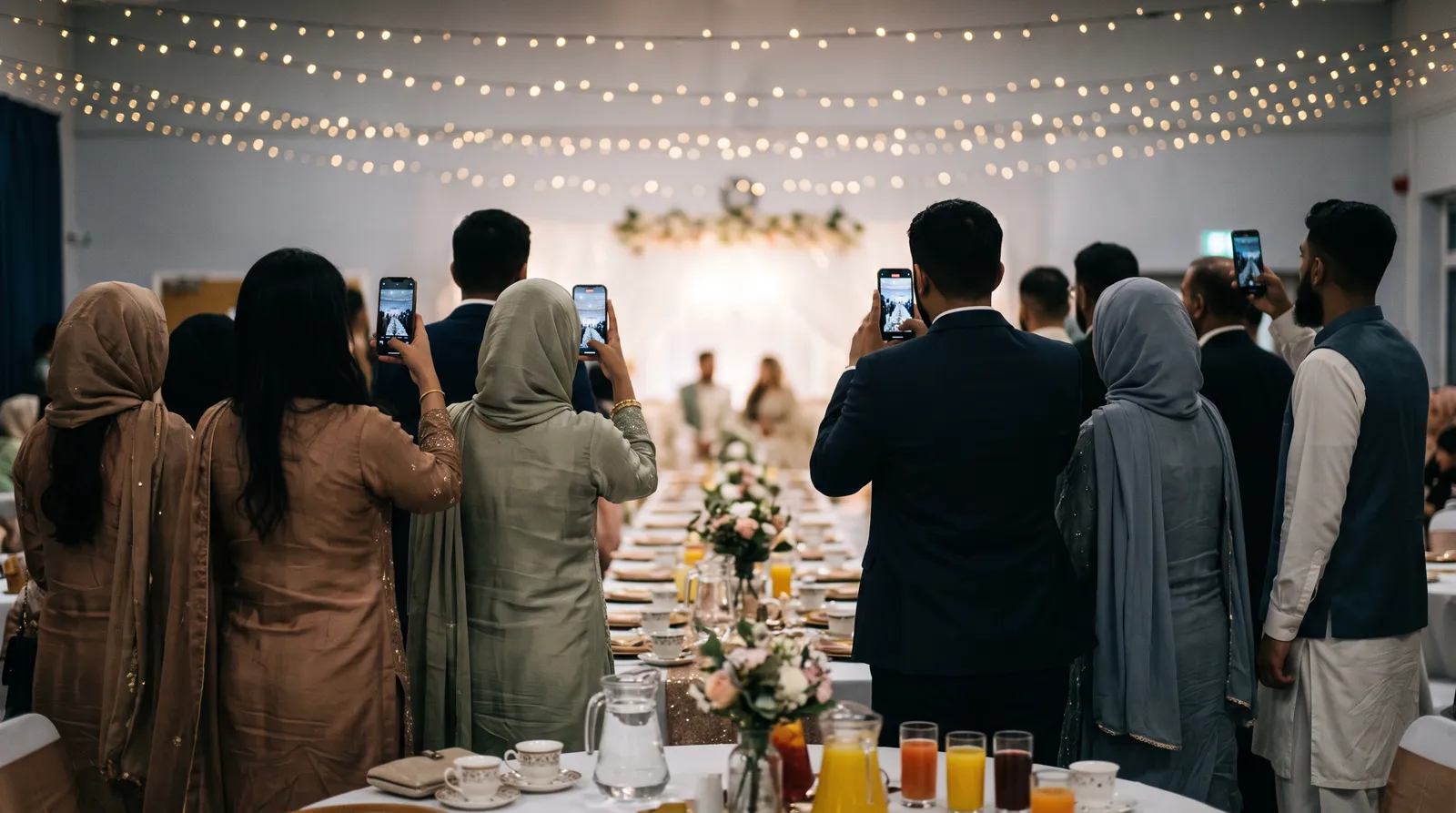
Two problems show up at every wedding, and neither is catering.
The first is the invitation. You have four hundred people across a dozen WhatsApp groups, half of whom have your mother's number and none of whom have each other's. Somebody forwards the details into a group you did not intend, and now the venue and the time are in front of people you did not invite.
The second is the photographs. Everybody takes them, nobody shares them, and the ones that do get shared land in a group chat where they compress to mush and then scroll away forever. Six weeks later you have the photographer's forty images and none of the three hundred your guests actually took.
Both are solvable, and the second one is what most couples end up caring about a year later.
One link, and it only works for the people you sent it to
A private event on Fazool has no public page. It is not indexed, it is not listed in any city feed, and there is no share block on it at all, because every link that block would generate is one a stranger meets with a refusal.
What it has instead is an invite link that you send. Anyone who opens it sees the event. Anyone who does not have it sees nothing, and pasting the URL somewhere public does not help them, because the working link is the invite token and not the address.
If somebody forwards the link into the wrong group, that is the same exposure a forwarded card has, and you can close it. What cannot happen is your wedding turning up in search results, or unfurling with the venue and the time when the link lands in a chat you were never part of. Paste it anywhere and it shows the Fazool name and nothing else. No title, no area, no address, no host, no guest count.
The exact address is a separate step. It is shown only to people you have approved, so a link that leaks does not hand over the venue.
Nobody has to be in a group chat
The thing a wedding group chat is actually for is announcements, and it costs you every guest's number in exchange.
An event page does the same job without the exchange. Everyone who says yes gets a reminder the day before and an hour ahead, automatically. If the venue changes or the doors move, you send one announcement and it reaches everyone who RSVP'd. Your guests never see each other's phone numbers, because nothing ever collected them.
You also get an actual number. Not reactions, not a rough count from three group chats, but a list of people who said they are coming, with a cap if you want one and a check-in you can tap at the door.
The album is the part people keep
After the event, guests add their photographs to a shared album on the event itself. Everyone who was there can see it, add to it, and save from it. That is the whole mechanism, and it replaces the group chat, the shared Drive folder nobody has the link to, and the USB stick that never gets made.
Two things about it are worth being precise on, because they are the reason it is safe to use for a wedding.
The album is not public, and it cannot be made public. Every photograph uploaded to an album is stored as attendees-only. That is not a setting somebody can get wrong. The upload path takes no visibility field from the app at all, so there is no toggle to mis-set and no way for a guest to widen it. Album photographs live in private storage and are served through short-lived signed links rather than a permanent public address. Cover images for public events are the only pictures that ever sit on an open URL, and a private wedding does not have one.
Nothing in Fazool leads a non-attendee to an album. There is no browsable gallery, no discovery surface, no "from this event" strip on a page a stranger can reach. If you were not at the wedding, there is no path to the photographs from anywhere in the product.
How do people find themselves in three hundred photos?
By being named, by hand.
Anyone who was there can tag anyone else who was there, and the tags build the set everybody actually wants, which is the photographs with them in. It works because a wedding roster is a few dozen known people rather than an open web of strangers.
Fazool does not run face recognition over your album, and that is a deliberate refusal rather than a feature we have not built yet. A photograph is one thing; facial geometry extracted from a photograph is biometric data under laws like Illinois BIPA, and the two large companies that ran matchers across user photo libraries settled those cases for $650 million and $100 million. A hand-placed tag on a known guest list is accurate enough and does not turn your wedding album into a database of faces.
What if somebody tags me in a photo I hate?
You remove it yourself, immediately, and it stays removed.
There is no approval queue before a tag appears, which is a real trade and worth stating plainly. A queue would move the work onto the person who did nothing wrong, and most of those queues never get emptied, so the names would sit pending forever and the feature would not exist. The cost is that a name is live before its subject has seen it.
Everything else is built around making that cost small. You are notified quickly, "remove me" is one tap from wherever you are looking, and removing yourself leaves a marker so the same person cannot put the name back. You do it once.
If it is the photograph itself you want gone rather than the tag, you can ask for it to be taken down, and the host answers that. A host can remove any frame from their own album.
Can guests see who else is invited?
Only if you let them.
The guest list is host-side. A fellow guest cannot open your roster, cannot see who was approved or declined, and cannot see who has paid for anything. That is the default.
If you want to go further, you can turn the guest list off entirely, and then guests cannot enumerate each other by name anywhere: not in the room, not in a members sheet, and not in the tag picker either, because a picker listing every attendee is that same enumeration wearing a different hat. Guests still see whoever chooses to speak or post, which is the difference between revealing people who put themselves forward and revealing the ones who did not.
Should the nikah and the walima be separate events?
Usually yes, because they generally have different guest lists.
Two private events with two invite links lets you send the nikah to family and the walima to everyone, without either group seeing the other's details or being able to reach the wrong page. Each gets its own album, which also matches how people actually want the photographs organized afterwards.
If you are also running a mehndi or a smaller family dinner, the same applies. Each one is a minute to set up.
What it costs
Nothing. There is no listing fee, no charge per guest, and no cut of anything, because no money passes through Fazool at all. If you are collecting contributions for something, you give guests the details you already use and the roster tracks who has paid.
The one requirement worth knowing: public events need a one-time ID check because they go out to strangers. A private wedding does not. An account is all it takes.
Setting it up
Create the event, mark it private, set the date and the venue, and send the link to the people you want there. Approve them as they arrive. Afterwards, tell everyone to add their photographs, and the album fills itself over the following week.
The thing you end up with is the part that lasts: three hundred photographs from thirty angles, in one place, visible to the people who were in the room and to nobody else.
Host an event, or read how to get people to actually turn up.
Related: Nikah checklist | What is mahr? | How to host an event people actually show up to