Muslim Men Are Lonely in a Full Room
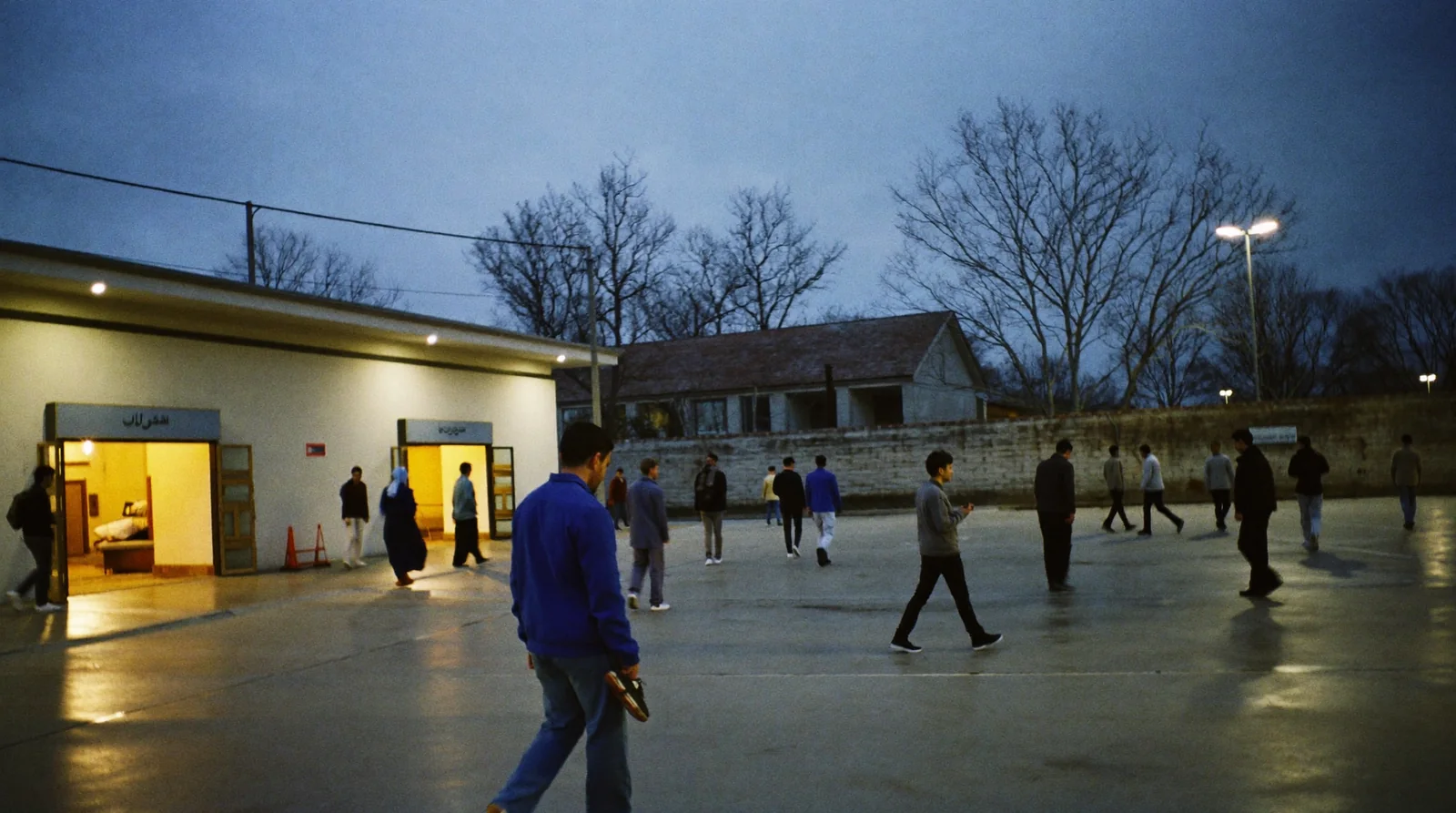
There is a version of male loneliness that is easy to picture, and it is a man alone in a flat who does not leave. That is not the version most Muslim men are living. The version most Muslim men are living involves standing in a room with three hundred other men every single week and knowing almost none of them well enough to call.
Both of those are loneliness. Only one of them is legible, and that is part of why the second one runs for years without anyone noticing.
Here are two facts that sit badly together. Muslim men in the United States attend weekly religious services at a rate of 57 percent, against 37 percent of Muslim women, and across 39 countries the split runs 70 percent to 42 percent.1 By the attendance measure, Muslim men are among the most reliably gathered men in the country. Meanwhile in England, where the government asks 175,000 people a year how often they feel isolated or lack companionship, Muslims came out as the loneliest faith group for the third year running.2
You can gather that often and still finish top of that table. Working out why is most of what follows.
The circle got smaller for every man in the West
Before anything specific to Muslims, the general picture, because Muslim men are men and the same decade happened to them.
In 1990, 55 percent of American men said they had six or more close friends. By 2021 that was 27 percent. Over the same period the share of men reporting no close friends at all went from 3 percent to 15 percent.3 The tail is the number that gets quoted, but the halving of the middle is the bigger event. Most men did not fall off a cliff into having nobody. Most men went from a circle down to a couple of people.
| Measure | 1990 | 2021 |
|---|---|---|
| Six or more close friends | 55% | 27% |
| No close friends | 3% | 15% |
Surveys disagree about the exact level. Pew asked a similar question in 2023 and got 9 percent of men reporting no close friends rather than 15.4 Different wording, different sample, different answer. What holds across all of them is the direction and the gender gap. Read these as a trend, not a scoreboard.
The rest of the picture is consistent. Americans socialised for 41 minutes on an average day in 2015 and 35 minutes in 2025, and the share doing any socialising at all on a given day fell from 38 percent to 30 percent.5 The share of Americans who regularly spend time in a third place, meaning somewhere that is neither home nor work, fell from 67 percent in 2019 to 54 percent.6 And young men carry it worse than anyone. Twenty-five percent of US men aged 15 to 34 told Gallup they had felt lonely a lot of the previous day, against 18 percent of young women and 18 percent of American adults overall.7
Those are the stakes and they are not decorative. Lacking social connection carries a premature death risk that the US Surgeon General's 2023 advisory put in the range of smoking up to 15 cigarettes a day, a comparison the advisory itself frames as a rough magnitude rather than a precise equivalence.8
Muslims gather more than almost anyone, and it does not close the gap
Now put Muslims into that picture, and the usual explanation stops working.
The obvious explanation for male loneliness is that men stopped going anywhere. The institutions emptied, the clubs closed, nobody shows up. That story fits a lot of American men. It does not fit this one. Muslims attend religious services weekly at 44 percent, against 23 percent of the general public, second only to white evangelicals.9 Within that, men attend far more than women, because jumu'ah is an obligation on men in a way it is not on women.
| Group | Weekly attendance |
|---|---|
| White evangelical | 59% |
| Muslim | 44% |
| Protestant | 39% |
| General public | 23% |
| Catholic | 22% |
| Jewish | 10% |
So Muslim men are in the room. The room is full, it repeats every seven days without fail, and it has done so for most of their lives. If attendance were the mechanism, Muslim men would be the least lonely men in the West.
There is a study that puts this uncomfortably plainly. Researchers looked at 446 first-generation Moroccan and Turkish migrants in the Netherlands, 259 men and 187 women, aged 55 to 66, and found that frequent mosque attendance was associated with greater loneliness in men, and not in women. Their reading was that the mosque may be the only meeting place a lonely migrant man has, and that the contact inside it tends to be superficial in content, focused on religious topics rather than on anything that would actually reduce loneliness.10
That is one study, in one country, in one age band, and it should not be stretched past what it is. But plenty of men will recognise it on sight. The masjid can be the place you go precisely because there is nowhere else to go, and going does not fix it.
Why does going to the masjid every week not fix this?
Because friendship is made of a specific input, and jumu'ah is almost entirely made of something else.
Jeffrey Hall at the University of Kansas ran two studies on this, one following 355 adults who had moved in the previous six months and one tracking 112 university freshmen over nine weeks. He found it takes roughly 50 hours together to move from acquaintance to casual friend, around 90 to become a friend, and more than 200 to become a close friend.11
The part that matters here is which hours count, because not all of them do. Time spent joking around, catching up, having a conversation that wanders, all of that moves a relationship along. Time spent sitting near someone in silence does not. Hall is explicit that people can log hundreds of hours alongside colleagues and stay acquaintances forever, because presence without exchange never compounds.
Now do the arithmetic on a Friday. Khutbah and prayer runs about forty minutes, and it is forty minutes of facing forward and not speaking, which is what the prayer is for. The socially live part is the few minutes in the courtyard afterwards, and most men are back in the car before it starts. Call it five minutes a week, generously. Fifty Fridays a year gets you a bit over four hours.
| Stage | Hours |
|---|---|
| A year of Fridays, unstructured time only | about 4 |
| Acquaintance to casual friend | 50 |
| Casual friend to friend | 90 |
| Friend to close friend | 200 or more |
None of this is an argument against jumu'ah. Jumu'ah is not there to make you friends. It is an argument about what jumu'ah leaves undone. The masjid reliably supplies the room and the repetition. It does not supply the hours, because the hours have to be unstructured and the whole design of the prayer is that it is not.
What is different about being a Muslim man specifically
Four things sit on top of the general picture. None of them are about faith being the problem.
The population is young, and young is the loneliest band. Twenty-six percent of American Muslims are aged 18 to 24, against 10 percent of the general public.9 That is not a rounding difference. It means the American Muslim community sits disproportionately inside exactly the age group Gallup found to be the loneliest, and the community's demographic centre of gravity is a group of young men in the years when friendship is hardest to rebuild and easiest to lose.
There is a background load that other groups do not carry. Sixty-three percent of Muslims reported religious discrimination in the past year, against 22 percent of the general public, and that figure has sat between 59 and 63 percent for nine years.9 Background hostility works against the one thing everything here depends on, which is walking into a room where you know nobody and accepting that you might be read wrong.
Muslim men report better mental health than Muslim women and ask for help less often. Seventeen percent of Muslim men rated their mental health fair or poor, against 29 percent of women, and 28 percent had ever seen a mental health professional against 36 percent of women.12 There are two ways to read that and only one of them is safe. Muslim men may be doing better. They may also just be reporting better, which the help-seeking literature keeps finding: stigma and reputational risk hold men back from saying anything, and the distress stays private until it escalates.13 The data cannot tell you which. It can tell you that fewer men walk through the door.
Loneliness is not considered a thing worth arriving with. This is the finding that lands hardest. A UK Muslim mental health service told researchers that 90 to 92 percent of the Muslims coming through their doors tick loneliness as something they are dealing with, and that almost nobody comes in for it, because it is not regarded as important enough in and of itself.14
This is why it is so hard to see from outside. It does not present. It arrives attached to something else, or it does not arrive at all, and in the meantime a man keeps going to jumu'ah every week and everybody assumes he is fine because he is there.
Converts deserve a line of their own here. Taking shahada often means losing an existing social world at the same moment as trying to enter one where everybody has known each other since childhood. The Equi researchers found cultural stigma compounding it further, with people hesitating to seek help for fear of judgement or of damaging their reputation, and in some cases withdrawing into what the report calls self-imposed reclusiveness.14
There is no survey that reports loneliness for Muslim men as a group. Not in the US, not in the UK. Every figure above is either about men in general or about Muslims in general, and the two are stitched together here by argument rather than by a dataset.
The England loneliness figure is also a single point of separation, at 8 percent of Muslim adults feeling lonely often or always against 7 percent for England as a whole. Muslims top the table, and the margin over the average is narrow. The more interesting part of that survey is not the gap but the pairing: two thirds of Muslims report a strong sense of belonging to their immediate neighbourhood, which is above the national average, and they still finish first for loneliness. Belonging and companionship turn out not to be the same measure, and that is the clearest evidence in the whole piece that a community can hand you one without the other.
The in-between is where friendship actually happens
Ask most men when they became friends with their closest friend and the answer is never the event. It is the drive home from the event.
Geoffrey Greif, who has spent a career studying male friendship at the University of Maryland, describes men's friendships as shoulder to shoulder rather than face to face. Men bond while doing something, not by sitting across a table and reporting on their feelings.15 The activity is not the friendship. The activity is the excuse that makes the friendship possible. Researchers have a name for where it actually lives. They call it the in-between. Not the game, the walk to the car afterwards. Not the halaqa, the twenty minutes in the car park nobody planned.
This is why a large annual dinner produces nothing and a small weekly thing produces everything. The dinner has no in-between. You arrive, you sit at an assigned table, you leave. The weekly football has forty minutes of in-between built into it and nobody had to organise that part.
It also explains the Friday arithmetic better than "people leave quickly" does. Jumu'ah is structurally all activity and no in-between, by design, because it is worship and worship is not supposed to be a networking window. Every masjid that has ever added a cafe or a youth space next to the prayer hall has been solving exactly this, and the ones that have done it report that it works.16
How long does it take to actually make a friend?
Longer than you want and shorter than it feels. Hall's thresholds give a real answer: fifty hours to a casual friend is about two hours a week for six months, and two hundred hours to a close friend is two hours a week for two years.
Those are not discouraging numbers once you see what they are asking for. They are asking for a slot in your week, not a personality change.
The failure mode is almost never being bad at this. It is expecting it in three weeks and stopping in week four.
What actually works
The advice here is unglamorous, and that is the reason it is worth anything.
Expect roughly half of those invitations to go nowhere and read nothing into it. Adults are busy and bad at replying. The half that land are the entire point.
There is one more reason to take this seriously, ahead of the usual self-improvement material a lonely man gets pointed at. The manosphere works as a commercial pipeline precisely because it finds lonely young men, hands them a grievance narrative and sells them the cure, and researchers following that pathway keep arriving at the same entry point: a need to belong that goes unmet, then gets met by the wrong thing and turns into anger.17 Four men who expect you on a Tuesday is not a small intervention against that. It is close to the only one that reliably works.
Where Fazool fits, narrowly
We are not going to claim an app fixes loneliness. Nothing in the research above supports that and pretending otherwise would be the kind of thing this piece exists to argue against.
Here is the narrow claim, and it is the only one the evidence supports. The masjid supplies the room. What it does not supply is the recurring, unstructured, shoulder-to-shoulder hours, and those have to come from somewhere else. Fazool's events feed is a list of that somewhere else in your city: football, book clubs, halaqas, hikes, game nights, fundraisers, the ordinary things that happen to be organised by Muslims. Browsing it needs no account, because a list of what is on this weekend should not be behind a signup.
Friends mode is same gender by design, brothers with brothers and sisters with sisters, and that is enforced in the data model rather than left to a setting. It is open to you married or not, and that matters more than it sounds. Married men lose friendships at the same rate as everyone else and have fewer acceptable ways to say so out loud.
The measure of whether it worked is whether you left the app and went. That is the only metric that means anything here.
See what is on near you, or start something if your city is quiet. A recurring coffee with four brothers is a real thing and it grows.
- Pew Research Center, Gender differences in worship attendance vary across religious groups, 2016.
- Community Life Survey 2024/25, fielded October 2024 to March 2025 with 175,000 respondents, reported in Hyphen, Muslims in England feel strong community links but remain lonely.
- Survey Center on American Life, American Men Suffer a Friendship Recession, drawing on the American Perspectives Survey.
- Pew Research Center, How many close friends do Americans have?, 2023.
- Bureau of Labor Statistics, American Time Use Survey, 2025 results.
- Survey Center on American Life data on third places, reported in The Nation, What's fueling loneliness in America today.
- Gallup, Younger Men in the U.S. Among the Loneliest in the West, aggregated 2023 and 2024 data.
- Office of the US Surgeon General, Our Epidemic of Loneliness and Isolation, 2023 advisory.
- Institute for Social Policy and Understanding, American Muslim Poll 2025, fielded by NORC at the University of Chicago, April to May 2025.
- Gender Differences in Social Embeddedness Determinants of Loneliness Among Moroccan and Turkish Older Migrants, PMC10873824.
- Jeffrey A. Hall, How many hours does it take to make a friend?, Journal of Social and Personal Relationships, 2018.
- Institute for Social Policy and Understanding, Distress and Disconnection.
- Mental health help-seeking among Muslims in the Liverpool City Region, PMC13052282.
- Equi, Tackling Loneliness: Learning From British Muslim Experiences, December 2024.
- Geoffrey Greif's shoulder-to-shoulder framing, summarised in Psychology Today, How the In-Between Helps Men Make Friends.
- Religion News Service, Mosque cafes brew community for younger, less religious generations of Muslims.
- Swallowing and spitting out the red pill: young men, vulnerability, and radicalization pathways in the manosphere, Journal of Gender Studies, 2023.
Related: How to make Muslim friends as an adult | How to find Muslim events near you | How to host an event people actually show up to