How to Make Muslim Friends as an Adult
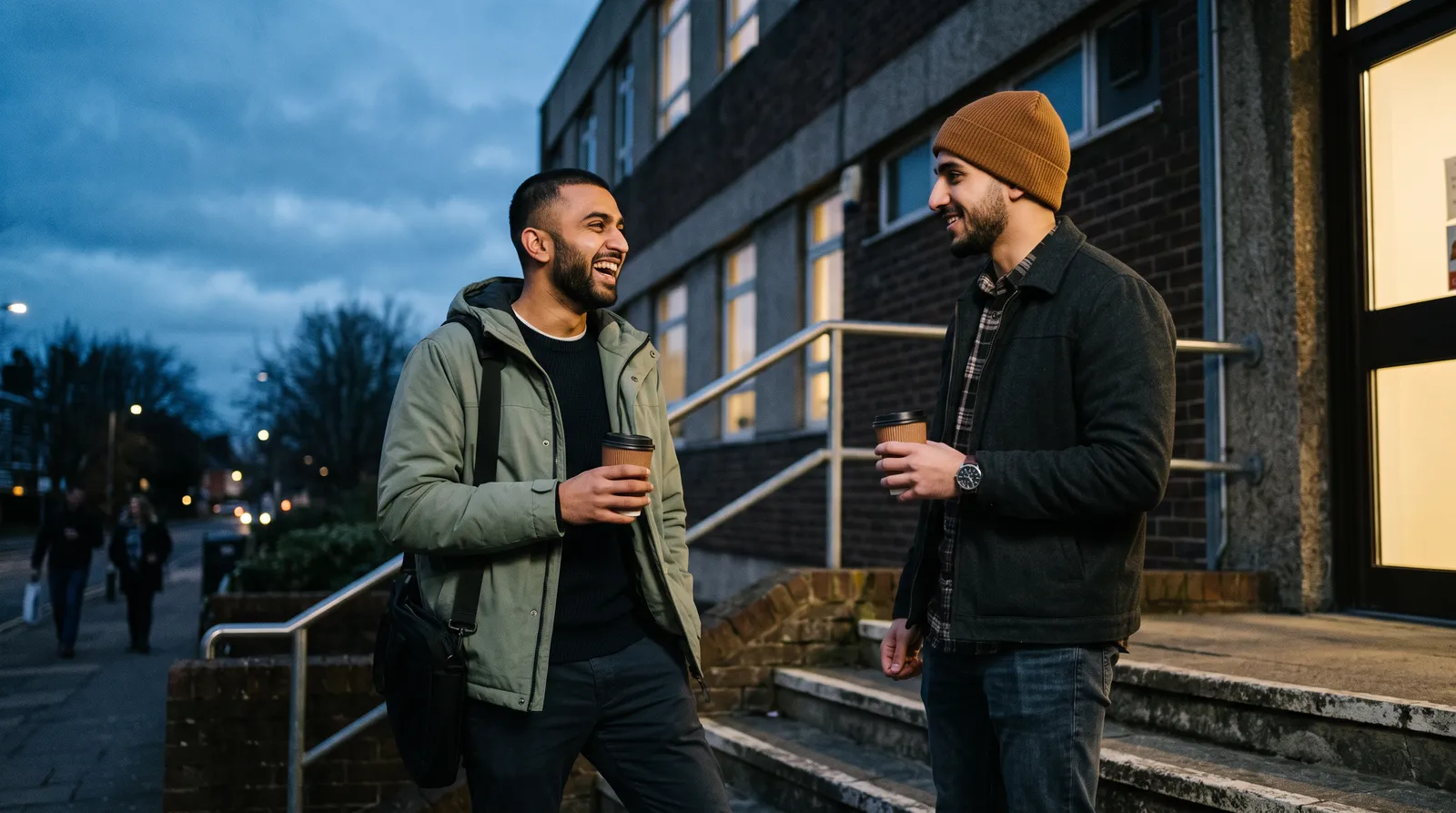
Nobody tells you that the friends you have at twenty-two were largely handed to you. School and university supply the two things friendship needs, which are the same people repeatedly and a lot of unstructured time. Then both disappear at once, and most people spend the next decade quietly assuming they have become worse at something they were never actually doing on purpose.
You have not become worse at it. The conditions changed.
Friendship needs proximity and repetition, not charisma
The research on this is unromantic and useful. Friendships form between people who are near each other, repeatedly, over time, with enough unplanned space for conversation to wander. That is essentially all of it.
Which means the instinct most people have, that they need to become more interesting or more outgoing, is aimed at the wrong thing. The person with lots of friends is usually not more charming. They are in more rooms, more often, with the same people.
This is genuinely good news, because attendance is a decision you can make and charisma is not. It also explains why a one-off event almost never produces a friend and a recurring one often does.
The three points where this gets hard
Most people arrive at this question from one of three places.
You left university. Your entire social infrastructure was a place you no longer go. The people are scattered across cities and the group chat is slowly dying. Nothing has replaced the mechanism.
You moved. You know no one, and the friendliness of a new city is almost entirely determined by whether you find the one repeating thing you can attend. People who find it in month one settle. People who do not can spend two years feeling like a visitor.
You took shahada. This is the hardest version and it deserves its own naming. You are often losing an existing social world at the same time as trying to enter a new one where everyone else has known each other since childhood and shares a cultural shorthand you do not have yet. Converts consistently report this as harder than any theological part of it, and they are usually not wrong.
Go where the repetition already is
The efficient move is not to organize your social life from nothing. It is to attach yourself to something that already repeats.
A weekly halaqa, a fortnightly football game, a class, a regular volunteering slot at the masjid. Any of these will put you in front of the same faces on a schedule, which is the mechanism. Volunteering is particularly effective and particularly underused, because working alongside someone skips several months of small talk.
The rule is to pick the recurring one over the impressive one. The annual dinner with three hundred people will get you nothing. The Tuesday study circle with eleven people will get you known by name in about a month.
Show up more than twice
The single most common failure is stopping too early.
Almost nobody makes a friend at a first event. You will have three surface conversations, come home, and conclude that these are not your people. Then you do not go back, and the whole thing gets filed as evidence that this does not work for you.
The third and fourth visits are where it changes. By then people recognize you, which means they start conversations rather than politely receiving yours, and someone eventually invites you to a smaller thing. That smaller thing is where friendships actually happen. The large event is only the doorway.
Give any given thing four attempts before you judge it. If four honest attempts produce nothing, it is the wrong room and you should try a different one, but judge it at four rather than at one.
Make the second invitation
Here is where most adult friendships die. Two people meet somewhere, get on well, exchange numbers, and neither ever follows up. Both assume the other was being polite.
Someone has to make the second contact, and it may as well be you. It does not need to be an occasion. "I'm going to the Saturday football, come" is enough, and it works better than a coffee invitation because it is low stakes for both of you and has a natural end.
Expect roughly half of these to go nowhere, and do not read anything into it. Adults are busy and bad at replying. The half that land are the whole point.
Why same-gender friendship is worth being specific about
Fazool's friends feature connects Muslims of the same gender only. Sisters meet sisters and brothers meet brothers, and this is a stated value rather than a limitation we plan to relax.
It exists because being clear about what something is makes people relax into it. A lot of Muslims will not use a general "meet new people" app, not because they object to friendship, but because the ambiguity means every interaction carries a question about what it is. Removing that question is what makes the thing usable, and it means married people can take part without it being strange, which most friendship apps quietly fail at.
What if you are a convert?
Two things help more than anything else.
Go to the same place repeatedly rather than sampling widely. Convert-focused circles exist in most large cities and are worth finding, but the broader point is that being a familiar face in one community beats being a stranger in five. The awkwardness of being new wears off through repetition and no other way.
Second, let people help. A lot of Muslims genuinely want to be useful to a new convert and have no idea how to offer without being patronizing, so they say nothing. Asking someone a direct question, including a practical one about where to buy something or how something is done locally, gives them a way in and is usually received well.
The cultural shorthand does come. It takes a couple of years and it is not a measure of anything.
How long should this take?
Longer than you want and shorter than it feels.
A reasonable expectation is that consistent attendance at one recurring thing produces people who know you within a month or two, and one or two real friendships within six months to a year. That sounds slow. It is roughly how long it took at university too, but you were not counting because the attendance was automatic.
The failure mode is not being bad at this. It is expecting it in three weeks and stopping in week four.
Where to start this week
Find one thing that repeats and go to it. That is the whole first step.
Fazool lists Muslim community events by city and browsing is free with no account. Sports, halaqas, classes, food, socials, and the ordinary things that happen to be organized by Muslims. If your city is quiet, hosting is also free, and a recurring coffee with four people is a real thing that grows.
See what is on near you, or start something.
Related: How to find Muslim events near you | How to host an event people actually show up to | What is Fazool?