How to Create a Muslim Marriage Profile That Works
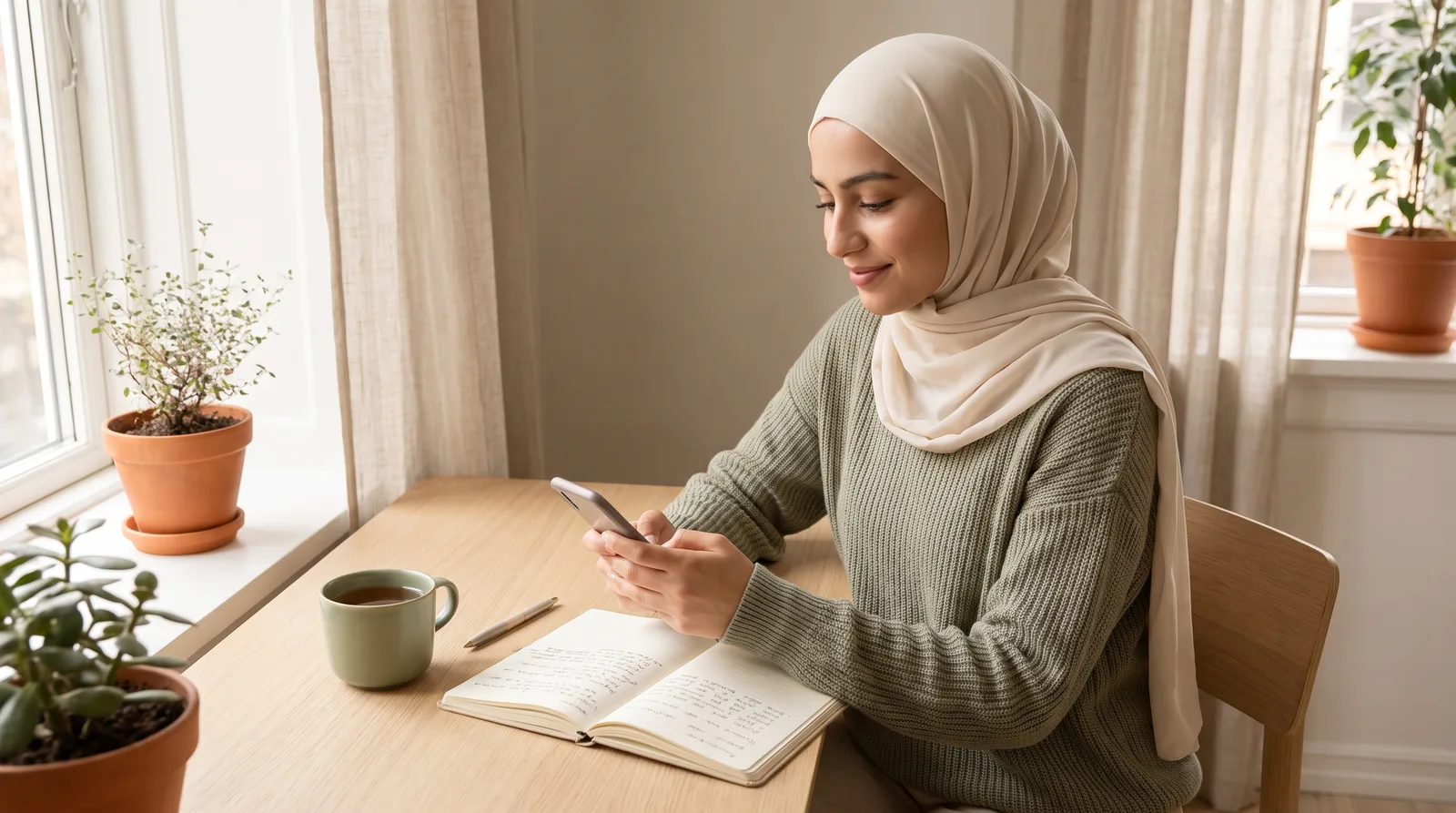
Your Muslim marriage profile is the first conversation you will ever have with your future spouse, and most people write it in ten distracted minutes. The research on what actually works is deeper than most advice admits, and almost none of it is about looking impressive. It is about being specific, being honest, and giving the right person enough real signal to recognize you.
The stakes are real. According to Pew Research Center, three in ten US adults have used a dating platform, and a Stanford study published in PNAS found that meeting online has become the single most common way American couples meet. What follows draws on peer-reviewed research, the published data of major platforms, and what the Muslim community itself keeps saying about profiles, good and bad.
What Makes a Good Muslim Marriage Profile?
A good Muslim marriage profile leads with your deen stated concretely, shows a real person in the photos and words, and demonstrates character instead of claiming it. On a marriage platform the goal is not to appeal to everyone. It is to be recognizable to the one person whose values already match yours, and to their family.
Demonstrating beats declaring, and this is one of the oldest findings in the field. In a foundational study of online daters in the Journal of Computer-Mediated Communication, Ellison, Heino, and Gibbs found that successful daters used anecdotes rather than assertions to establish credibility: not "I am funny" but a line that is actually funny. The Muslim community has learned the same lesson the hard way. Community writing on Muslim marriage apps documents that women specifically screen out men whose bios lead with "loyal, honest, and religious," because experience taught them those words are claims, not evidence. Even Muzz's own profile guidance warns against bios stuffed with hadith quotations and generic phrases like "I'm a loving person."
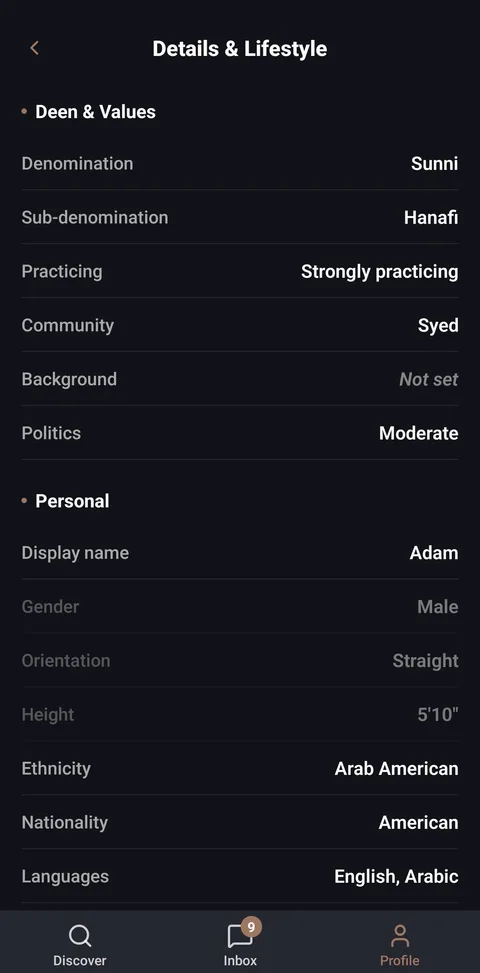
So state your practice plainly and let the details carry it. Fazool gives your deen a structured home: denomination, sub-denomination, practicing level, community, and values each have their own field, which means the person filtering for a strongly practicing Hanafi does not have to guess from your adjectives.
The guidance most Muslims grew up with points the same direction:
"A woman is married for four things: her wealth, her lineage, her beauty, and her religion. So choose the one who has religion."
Sahih al-Bukhari 5090
That is what the serious person reading your profile was raised to look for. Make it easy to find.
What Photos Should You Use?
Use recent, unedited photos where your face is clearly visible in good light, because the judgment happens faster than you think. In a well-known Princeton study published in Psychological Science, Willis and Todorov showed that people form stable impressions from a face within 100 milliseconds, and of every trait they measured, trustworthiness was the one people judged fastest.
Editing works against you, and the research here is specific. A study in New Media and Society found that men rated beautified photos of women as more attractive but significantly less trustworthy than natural ones. Related work by Toma and Hancock in Communication Research found photos are the single least accurate element of dating profiles. The community's rules of thumb match the labs: Salams' own photo guidance calls a hidden face the biggest conversion killer, Muzz reports that Snapchat-filtered photos get the lowest match rates of any photo type, and community red-flag lists single out sunglasses shots and luxury-flex photos of cars and watches as the fastest ways to get screened out.
- Face clearly visible, good light. The 100 ms judgment needs something real to work with.
- Recent and unedited. No filters. Enhanced photos measurably cost you trust.
- Three or four that tell a story. One clear portrait, one doing something you love, one in your everyday life.
- No sunglasses, no group-only shots, no car-and-watch flexing. All three are documented community red flags.
- Modesty is fully supported. On Fazool, every photo passes human review, and sisters can keep photos blurred by default, revealed only when they choose.
What Should You Write in Your Bio?
Write specifics, not categories. This is the most repeated advice across every source type, and it now has direct experimental support. A 2022 study in PLOS ONE that had 1,234 people rate hundreds of real dating profiles found that perceived originality in profile text strongly predicted perceived intelligence, which in turn predicted romantic attractiveness, with humor carrying a comparable effect. Crucially, more original profiles were rated as less odd, not more. Being distinct reads as smart, not strange.
Here is what that looks like in practice:
"Religious, family-oriented, love to travel and try new food. Looking for someone loyal and honest. Whatever you want to know, just ask."
"Fajr at the masjid, then a 6am gym session my brother talked me into and now cannot escape. Engineer who cooks a genuinely dangerous nihari. Looking to involve both families early. What dish would you enter into a cooking competition?"
Every claim in the second bio is an anecdote doing the work an adjective fails to do, and it ends with a question a stranger can comfortably answer. That ending matters: Hinge's published data shows likes on written profile content are 47 percent more likely to lead to a date than likes on photos, and likes with a comment are twice as likely to convert. Words give people a door. And brothers should take the writing at least as seriously as the photos: in the classic economics study of online dating by Hitsch, Hortaçsu, and Ariely, men weighted photos far above text, but women weighted the written profile and the photos roughly equally. She is reading. Give her something to read.
On Fazool your bio works alongside a dedicated dealbreaker field, shared before a match opens, so the thing you most need known is delivered by the app itself, at exactly the right moment.
Do Voice Notes Actually Help?
Yes, and the evidence is some of the strongest on this list. In a PLOS ONE study by McAleer, Todorov, and Belin, listeners formed consistent judgments of trustworthiness, warmth, and confidence from voice clips averaging just 390 milliseconds, a single spoken "hello." Your voice carries credibility signals a photo physically cannot. Platform data agrees: in a Hinge Labs survey of roughly 30,000 daters, conversations that included voice notes were 41 percent more likely to lead to a date.
Every Fazool profile can carry a 60-second voice note, reviewed before it goes live. You do not need a script. Say salaam, say what you are looking for, and let one genuine sentence about your week do the work. It is the hardest part of a profile to fake and the easiest part to trust.
How Honest Should You Be?
Completely, and not only because it is right. When researchers verified real daters' profiles against measurements, about 80 percent had misstated height, weight, or age. The lies were small, which is exactly the point: everyone shades a little, everyone expects the shading, and the person who simply does not becomes memorable. Later work by the same group reframed the profile as a promise about who will show up, and on a marriage timeline every small exaggeration becomes a first-meeting disappointment with two families watching. Be equally direct about the big things: Salams' advice column is blunt that a previous marriage disclosed late is far more damaging than one disclosed on the profile, and Muzz names exaggerated prayer habits as the misrepresentation that most reliably ends in rejection once the truth surfaces.
Write for the family too.A study in the Journal of Religion and Popular Culture found that on the largest Muslim matrimonial site of its era, roughly 70 percent of profiles were posted by parents. In this community a profile is read by mothers and walis as much as by matches. On Fazool that is built in: a wali or chaperone can follow the search with read-only access, so write every line as if her father will read it. He might.
Fazool's structure rewards the honest profile. Every member is ID-verified before they can message anyone, dealbreakers surface before a match opens, and community ratings after real conversations mean your reputation follows how you actually treat people. The profile that works here is not the most polished one. It is the one that tells the truth well, in your own voice, about your deen, your life, and the marriage you are ready for.
Related: What Is Fazool? | How Dealbreaker Disclosures Work | Questions to Ask Before Marriage | How ID Verification Works